

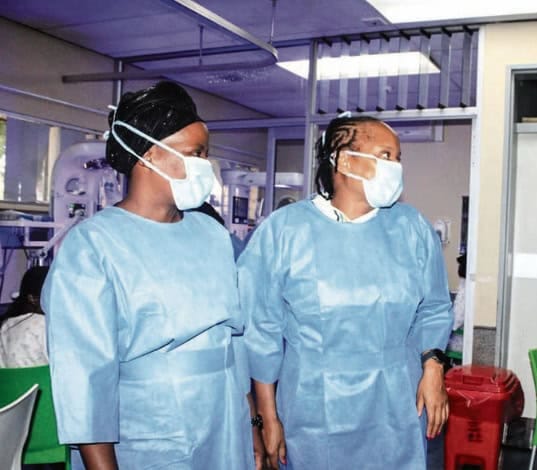
Limpopo premier, Dr. Phophi Ramathuba and Health MEC, Dieketseng Mashego, during the visit to Mankweng Tertiary Hospital, where conjoined twins are expected to undergo separation surgery.
The 29-year-old woman from Phalaborwa who gave birth to conjoined twins at Mankweng Tertiary Hospital on January 28 remains hopeful ahead of a life-changing surgery.
The woman, who was first admitted at Maphutha Malatjie Hospital was urgently transferred to Mankweng Tertiary Hospital when the condition was detected during labour.
According to the provincial Department of Health, the twins were successfully delivered and are currently stable, receiving care in the Neonatal Intensive Care Unit. Departmental spokesperson Neil Shikwambana said,“Initial assessments indicate that the babies were joined at the abdomen.”
He said specialists are conducting further assessments to better understand the twins’ anatomy and determine the most appropriate course of care.
The mother is reported to be in good condition and continues to receive specialist support.
“At present, the twins are clinically stable and progressing well,” said Shikwambana.
A multidisciplinary medical team has already been established to manage the case.
“The team will meet weekly to conduct thorough assessments, plan ongoing care, and prepare for a possible surgical separation when clinically appropriate,” he said.
Health MEC Dieketseng Mashego and Premier Dr Phophi Ramathuba have visited the health facility to offer support to hospital management, healthcare workers, and the mother.
Dr Nyaweleni Tshifularo, a pediatric surgeon at Mankweng Hospital, told the media that stabilising the babies was the immediate priority.
“The first step was to stabilise the babies. So, after the birth of the babies, we went on just to resuscitate and make sure they are alive, they are healthy. And now we had to go through the stages of examining, scanning them to see which part of the body are joined together. We’ve got that information. And now the medical team are going to sit down and have a discussion.”
Tshifularo explained that the twins are joined at the chest, describing the outcome as a “blessing from God”.
“This is a common part. And most of it, we’re not sure really what caused it, but it’s related to the separation that didn’t happen properly. The cell that was supposed to be one cell in the middle divided into two.”
South Africa has previously managed several rare, conjoined twin cases, including the 1986 separation of Mpho and Mphonyana Mathibela at Chris Hani Baragwanath Hospital, and the successful separation of craniopagus twins Siphosethu and Amahle Tyhalisi at the R2d Cross War Memorial Children’s Hospital in 2021.