

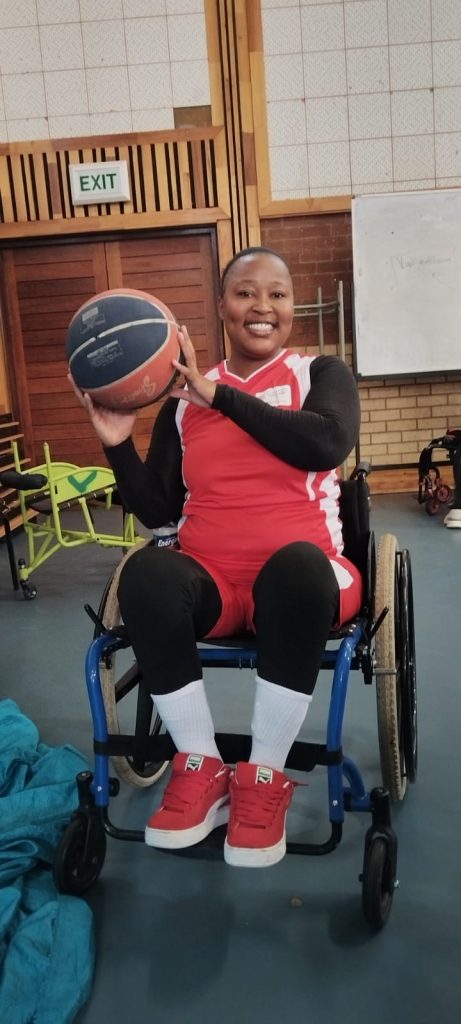
Wheelchair basketball star, Moloko Pula breaks multiple barriers despite her disabilities.
Moloko Pula, 34, an acclaimed para-athlete and beauty queen; says despite her resilience as an advocate for the rights of people living with disabilities, she constantly faces multiples barriers while trying to access healthcare.
Moloko from Ga-Semenya village in the Moletjie area, northwest of Polokwane in Limpopo says on 11 March 2020 she went to Steve Biko Academic Hospital in Pretoria to deliver her son when an anesthetic injection badly affected her spinal cord.
“I was pregnant when I was rushed to the hospital with severe labour pains before I could deliver my son, Keabetswe. After realising that my baby was in grave danger, the doctor rushed for emergency C-section. I was informed that epidural injection was administered and seemingly the procedure was not done properly. The injection left blood clots on my spine and caused severe nerve damage. Even after delivering the baby, I still felt numb from my waist down and never felt any contractions.
Since then, I couldn’t walk on my own again;” she says.
“While I was still studying in Pretoria, I had to attend my routine sessions for hyperthyroidism treatment at Tshwane Rehabilitation Hospita after every six months. After returning to my village; I used to spend about R1100 for a return trip wih a shuttle. I was later transferred to Pietersburg Hospital to get the same treatment for my spine surgical therapy. I have to visit the hospital once a month to be checked by specialists, who are mainly available on Wednesdays,”
Moloko describes the past six years as the most frustrating times of her life confined to a wheelchair.
“Now that I’m wheelchair-bound, I have to rely on other people for mobility. The most stressful part is when you have to access healthcare facilities far away from home using public transport. One day when I was on my way to my medical checkup in Polokwane, a taxi driver refused me to board his cab, saying his car had no space for my wheelchair. I have to travel for about 30 kilometers every day to Polokwane where I work for Disability People South Africa;”
Despite her disabilities, Moloko continues to break the glass ceiling by curving a niche for herself as a para-athlete, beauty queen and motivational speaker who advocates for the human rights of disabled athletes.
“I’ve always been an active person who participated in various sporting codes. Modeling was one my childhood dreams to become a world-renowned beauty queen. Even after being confined to a wheelchair, I still wanted to pursue those dreams.
I am the current 1st runner-up of the 2025/26 Miss South Africa Disability contest and obtained silver medal during the 2026 National Javelin Throw Championships.”
As a motivational speaker, Moloko is also an ambassador for disabled athletes and beauty queens.
“There is a deep stigma attached to people with disabilities. This creates huge barriers them to realise their potential. Disabled people are often marginalised in sports, workplaces and everywhere in society. As ambassador, I strive for their rights and recognition to be treated fairly. We play sport under harsh environments where we’re forced to rely on broken wheelchairs. This often limit our potential while we are already facing physical and psychosocial challenges,” she says.
Lehlogonolo Rakolo, the chairperson of Limpopo Wheelchair Basketball says most disabled athletes and federations are even marginalised by
government and corporate companies.
“We’re forced to compete in poorly maintained facilities which are not accessible by wheelchairs. These amenities have no ramps, adapted bathrooms, making it impossible for wheelchair athletes. It is even worse since we don’t have sports psychologists during major tournaments,” he says.
Kwena Lamola, provincial manager of DPSA in Limpopo says people with disabilities are confronted by lots of barriers, including limited access to health services and access to assistive devices and technology.
“Persons with disabilities often experience stigma arising from negative attitudes, stereotypes, misconceptions and lack of understanding about disability. The stigma can affect their dignity, confidence, relationships and ability to participate fully in society.
As DPSA, our main core programme is to advocate for the rights of persons with disabilities.”