

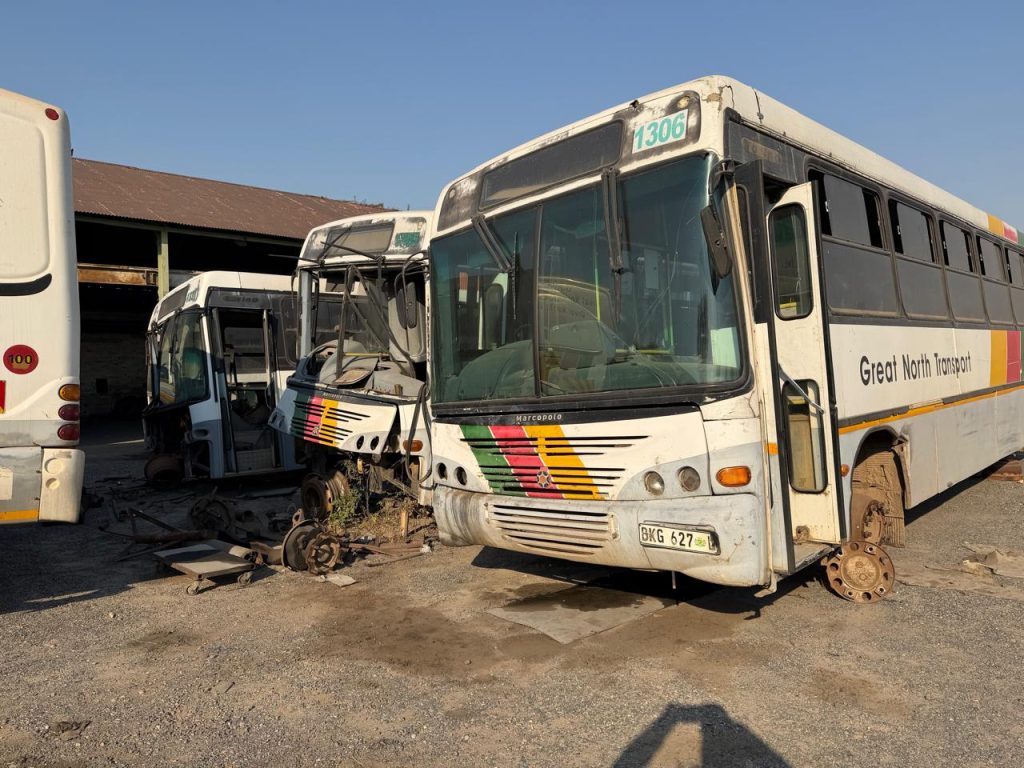
State of Great North Transport’s Phalaborwa Depot
THE Companies and Intellectual Property Commission (CIPC) has given state-owned bus company, Great North Transport (GNT) until August 31 to present a comprehensive turnaround strategy.
Unless otherwise, the cash-strapped company could face a directive to cease operations or alternatively be placed under business rescue.
Even after a cash injection of a whooping R1 billion in taxpayer funding into GNT since 2016/17, the entity remains financially distressed and teetering on the brink of collapse.
Processes have already begun to retrench employees.
Despite this, GNT says it requires another R198.848 million in bridge financing and warns that without it the company could collapse before reaching break-even.
GNT’s long-standing financial woes resurface with retrenchment processes after management reportedly issued a Section 189 notice under the Labour Relations Act, initiating consultations on possible staff shedding.
In a statement issued earlier, the Democratic Alliance (DA) expressed concern over the reported move and called on MEC for Economic Development, Environment and Tourism, Tshitereke Matibe, to explain why retrenchments are being considered.
The opposition party said the Matibe should disclose how many employees could be affected, whether alternatives to retrenchment had been explored, and what impact the move could have on commuters who rely on GNT’s services.
The DA said employees should not bear the consequences of years of financial mismanagement and governance failures, adding that retrenchment should be a measure of last resort.
The entity has been battling operational and financial instability for more than a decade, and was effectively placed under national administration between 2011 and 2015 as part of a broader intervention in the province.
Numerous turnaround strategies since then have failed to pull the transport provider back from the brink.
Last year, GNT suspended its top executive, including CEO, CFO and COO amid allegations that the company owed millions of rand to pension fund schemes and in unpaid employee benefits.
In his budget vote speech to the Legislature in May, Matibe said he had instructed GNT to submit a six-month turnaround plan, with progress to be reported on a biannual basis, and pledged to strengthen the entity’s institutional capacity from the 2026/27 financial year onwards.
He said GNT, backed by the provincial government, had purchased 71 new buses, which were expected to be delivered in batches and integrated into the network before the end of the financial year.
DA spokesperson on Economic Development, Environment and Tourism, Jacques Smalle said his party is deeply concerned by reports that GNT has issued a Section 189 notice initiating consultations on possible retrenchments.
“For years, the DA has warned that GNT’s deteriorating financial position, operational instability and governance failures would ultimately threaten both the sustainability of the company and the livelihoods of its employees. Despite these warnings, the ANC-led provincial government has repeatedly assured the public that GNT was being stabilised through bailouts, fleet renewal and turnaround interventions.
MEC Matibe must explain this contradiction. He must tell the people of Limpopo what has changed, whether the turnaround strategy has failed, why the Legislature has not yet been informed, and how the company reached a point where jobs may now be at risk;” Smalle said.