

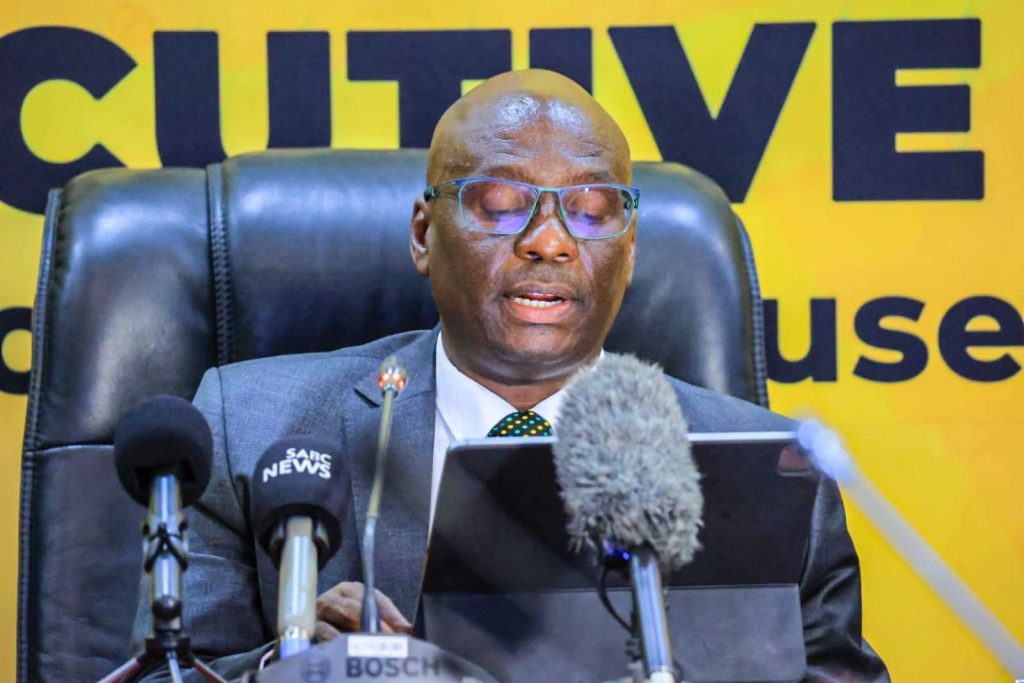
ANC Provincial Secretary, Vhamusanda Reuben Madadzhe.
The Polokwane Local Municipality faces a tense political atmosphere this morning as the first council sitting convenes to constitute the municipal council and elect its office bearers.
Despite the urgency of establishing the city’s leadership structure, the African National Congress (ANC) has delayed announcing its mayoral candidate and the municipality’s troika, also known as the Political Management Team.
This hesitation comes at a critical moment for the capital city of Limpopo. Following the recent local government elections, Polokwane became a hung municipality after no single party won an outright majority of the 46 seats needed to govern alone.
The ANC emerged as the largest party with 37 of the 90 council seats, followed by the Economic Freedom Fighters with 17 seats, the Democratic Alliance (DA) with 11 seats, ActionSA with 10 seats, and the South African Communist Party (SACP) with six seats.
While the ANC provincial leadership announced its troikas for eight other hung municipalities across Limpopo ahead of their council sittings, Polokwane was noticeably left off the list. The core reason the announcement was withheld stems from deep internal friction over who the party should partner with to secure a governing majority.
According to internal party sources and a widely circulated graphic reflecting the concerns of ordinary ANC members, an agreement had already been reached at the local level between the ANC and its traditional alliance partner, the SACP. Combining the ANC’s 37 seats with the SACP’s six seats would bring them to 43 seats, leaving them just three seats short of a majority that could easily be bridged with smaller parties.
However, provincial leaders, specifically the ANC Provincial Chairman and Provincial Secretary, reportedly instructed the Peter Mokaba Region to halt all coalition talks with the SACP. Instead, senior provincial figures allegedly prefer forming a working arrangement with the DA, whose 11 seats would push a combined bloc to 48 seats.
This alleged preference for the DA over a deal with the SACP has sparked fierce backlash among grassroots ANC members in the region. Rank-and-file members have openly questioned the motives of the provincial leadership, asking whether the directive to abandon the SACP is driven by ill-discipline, political immaturity, or personal hatred against the communist party.
As councillors take their oaths and enter the chambers this morning, the unresolved coalition battle leaves an executive leadership vacuum in Polokwane. Political observers warn that failing to finalize a troika and a stable governing pact before the sitting risks plunging the municipality into administrative paralysis.
Without clear leadership, vital service delivery decisions regarding water infrastructure and local economic development face immediate delays.
Behind closed doors, frantic negotiations continue as regional and provincial leaders try to manage the fallout. For the residents of Polokwane, today’s inaugural council sitting marks the start of an uncertain and high-stakes battle for control of the city.