

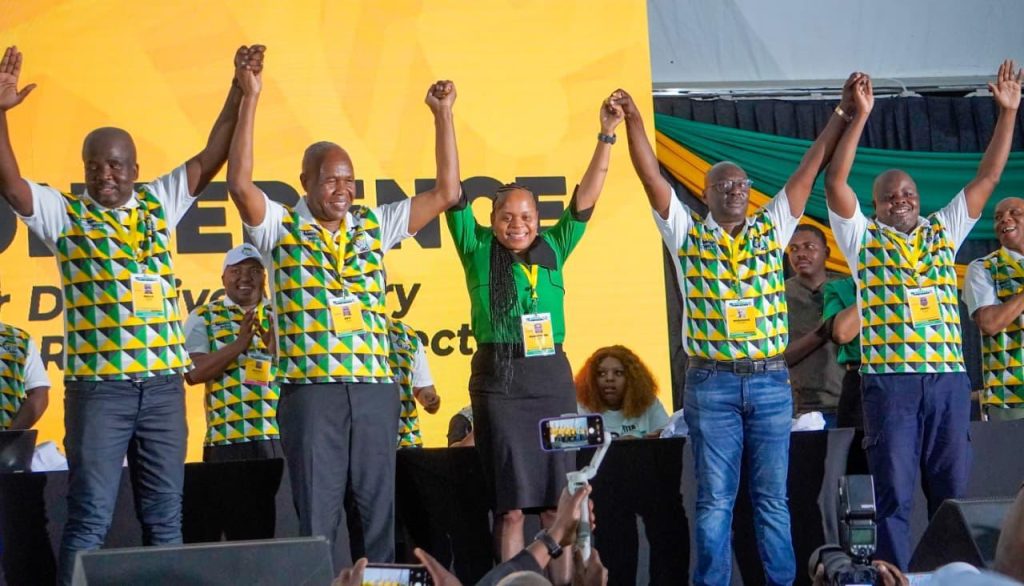
The newly elected Provincial Treasurer: Eddie Maila, Deputy Provincial Chairperson: Makoro John Mpe, Provincial Chairperson: Dr. Phophi Constance Ramathuba, ANC Provincial Secretary: Reuben Madadzhe and Deputy Secretary: Pule Shayi.
The atmosphere at the ANC Limpopo Provincial Conference on Sunday afternoon was a masterclass in political pragmatism.
Despite whispers of potential disruptions, the “unity slate” held firm. By the time President Cyril Ramaphosa rose to deliver the closing address, the message was clear: Limpopo had chosen stability, driven by a grassroots mandate that many analysts failed to anticipate.
A Mandate of Real Unity
The conference proved that this Provincial Executive Committee (PEC) is not merely a negotiated settlement from the top, but a real unity enforced by the democratic branches.
In a clear directive to provincial leaders, the branches signalled an end to the culture of “wishing each other away.” The result is a leadership collective where everyone has a seat at the table.
In her maiden address as Provincial Chairperson, Dr. Phophi Constance Ramathuba emphasized this shift toward collective responsibility. She noted that the province could no longer afford the luxury of internal friction while the people demanded service delivery.
“Our mission is greater than our personal ambitions,” the Chairperson stated. “We are here to consolidate the gains of the movement and ensure that Limpopo remains a bastion of the African National Congress.”
Winners and Losers: The Power of the Regions
The elections provided a thesis on the power of the branch structures, with the regional results telling two very different stories.
The Peter Mokaba Region emerged as the undisputed heavyweight of the conference. Boasting a massive 10-seat haul in the PEC, the region’s influence is now undeniable. Polokwane Mayor John Mpe received special praise for fostering this environment. Despite open differences in the past, Mpe supported comrades he had previously disagreed with, embodying the unity in practice that defined the weekend.
In stark contrast, the Sekhukhune Region became the biggest loser of the weekend, securing only two PEC seats. This outcome was widely interpreted as a punishment by branches for the Sekhukhune Regional Secretary’s continuous “reckless statements” that undermined the centrality of the branches. Tellingly, the two individuals elected from Sekhukhune are known not to be preferred by the “bully of branches.” For many in the hall, this was a clear wake-up call for reflection.
In regions like Norman Mashabane and Vhembe, candidates who were reportedly not wanted by certain factions made the grade against all odds, proving that the branches remain superior to any individual political broker.
Shifting Chairs and the Road Ahead
While the top leadership found safety in numbers, the hierarchy has shifted. Key figures like Basikopo Makamu, Florence Radzilani, and Nakedi Kekana were returned as additional members, vacating their former roles as Deputy Provincial Secretary, Deputy Chairperson, and Provincial Treasurer.
The focus now moves to the municipal musical chairs in the Mopani district. Pule Shayi is widely expected to move to the province, likely leaving the current Letaba Mayor and Norman Mashabane Deputy Regional Chairperson, TD Mamanyoha, to take the reins in Mopani.
In Greater Tzaneen, a vacuum looms following the double defeats of Gerson Molapisane at both the regional and provincial levels. His likely exit from the political stage opens the door for new leadership in the province’s best-run municipality, with Mopani’s head of infrastructure, Masilo King Solomon Maloko, among those touted for the mayoralty.
The President’s Closing Note
As President Cyril Ramaphosa closed the proceedings, he praised the province for demonstrating that unity and democracy can co-exist. He framed the conference as a victory for the renewal project, urging the newly elected leadership to focus on the professionalization of local government.
The President’s message was a subtle warning to those with national ambitions: if you have learned nothing from the Limpopo experience—that branches are the lifeblood of the movement—you risk the same political isolation seen in Sekhukhune.
Conclusion
Limpopo’s conference was a demonstration of strategic alignment. The unity slate did more than just survive; it adapted to a mandate delivered directly from the floor. The province has avoided the shocks many feared, but the true test of this unity will be found in how the new PEC manages the upcoming transitions in Mopani, Tzaneen, and Greater Letaba. For now, the ANC in Limpopo has proven that when branches lead, the movement stands.
Start profiting from your network—sign up today!