

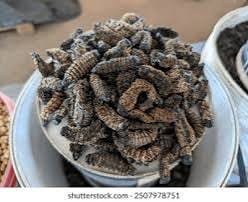
Lack of rainfall and escalating drought have rippling effects on the mopani worms business.
The current lack of rainfall and escalating drought conditions —largely driven by regional climate variability and El Niño shocks — are severely crippling the Mopani worm business in the Mopani District Municipality and across broader Limpopo.
Because the lifecycle of the emperor moth larva (Gonimbrasia belina) is entirely climate-dependent, the lack of precipitation is altering both the local ecology and the rural economy in various parts of Mopani region.
Mopani worms thrive under steady early-season rainfall, moderate temperatures and abundant green foliage on Mopani trees.
Harvesters who historically gathered hundreds of 50kg bags say they are now struggling to fill small 25-liter buckets.
The severe local supply deficit has forced traders to import Mopani worms from neighboring countries like Botswana, Zimbabwe, or Zambia.
Due to added cross-border transport costs and customs duties, retail prices have skyrocketed — in some areas, the cost of a standard 20-liter bucket has surged from R350 to as much as R1,500.
The Mopani worm business is a cornerstone of economic survival in the province, particularly for rural women who represent roughly 60% to 70% of the harvesting workforce.
In villages like Muyexe and Nsavulani, sales from these worms serve as the sole source of income for up to 55% to 70% of harvesting households.
The drought leaves these families with zero safety net during peak seasons.
Small commercial agro-processors that package Mopani worms into snacks, spices, or protein supplements are unable to secure predictable raw stock.
Tsakani Mathebula says they have been forced to pause operations, halt supply agreements with major retailers, and lay off staff.
She says the lack of rain has also triggered secondary threats to the industry.
“Because households cannot make money from the worms, some resort to cutting down Mopane trees to sell as firewood or charcoal for survival. This deforestation could permanently destroy the very habitat the caterpillars need to bounce back when the rains eventually return.”
Peter Maringa says the unavailability of the worms has severely affected his livelihood.
“We have not seen them in years. They were all over this place. We don’t understand what happened to them. Without them it has been a struggle for us to make profit” he said.
Mopani worms season normally starts in October and they thrive in rainy conditions so if it doesn’t not rain enough, they will all die.
Community leaders have attributed the disappearance of mopani worms to the large-scale debushing of mopani trees over the years.
Eric Ntshengedzeni, says some community members chop the trees down to gather firewood for both domestic and business purposes.
“People continue to chop the trees down and I think the government must stop this. They must outlaw the cutting down of the trees” he says.