

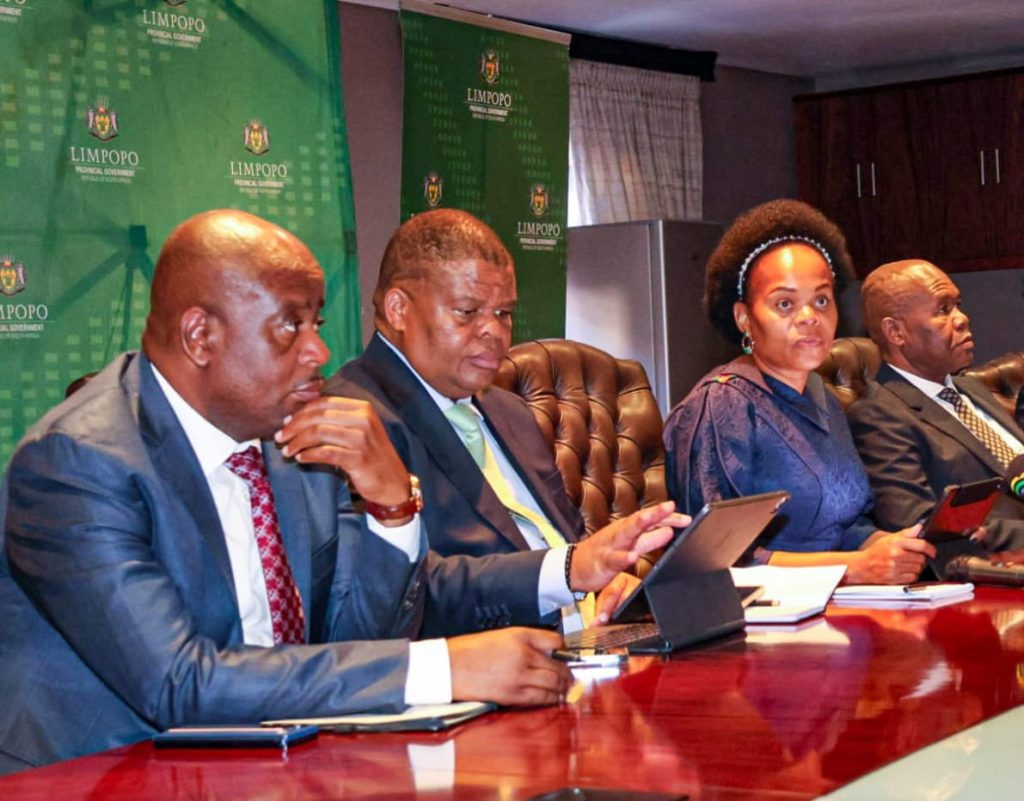
The Water War Room, comprising Coghsta MEC Basikopo Makamu, Deputy Minister David Mahlobo, Premier Phophi Ramathuba and Polokwane Mayor John Mpe says the water crisis in Polokwane needs urgent intervention.
The Polokwane municipality says it has embarked on intensive remedial measures to resolve the ongoing crisis. On March 11, a press briefing was held at the Office of the Premier in Polokwane where the recently established Water War Room sought to outline a comprehensive plan of action to address the water disaster.
The delegation included Premier Dr. Phophi Ramathuba, Deputy Minister of Water and Sanitation, David Mahlobo, Polokwane Executive Mayor, John Mpe, MEC for Cooperative Governance, Human Settlement and Traditional Affairs, Basikopo Makamu and CEO of Lepelle Northern Water (LNW) Corneleus Ruiters. Both conceded that Polokwane is tightly gripped by a chronic water crisis, reiterating the need for an urgent intervention.
In various parts of Polokwane, residents insist that the problem is far from being resolved as they continue to drink “unsafe water” which they say is a health hazard. Scores of Seshego residents say they are subjected to consume water that “tastes horrible”, accusing the municipality of persistent failure to deliver clean water. From late December and early March, residents have complained of contaminated water which allegedly caused health complications.
The municipality resorted to flushing gallons of water through fire hydrants despite the perpetual scarcity.
Despite wasting so much water, residents confirmed that they continued to experience contaminated water coming out of their taps. Pensioner Tryphosa Manyathela says the municipality’s remedial methods did not work as the water is still unconvincingly clean.
“In the early hours of the morning, the water is still brownish. However, during the day, it looks clean but still tastes horrible. We have alerted the municipality about this problem but the problem still continues. We have stopped drinking this dirty water and opted to buy water from retailers. Clearly, this problem is far from over,” she said.
Manyathela’s sentiments are echoed by another resident Ngwako Mamadi. He says, “I have stopped consuming water from the municipality two weeks ago after experiencing diarrhea and abdominal pains. I can’t run the risk of consuming water that tastes so bad. I’m on medication and I can’t take the risk of consuming my medication with this filthy water.”
Addressing the media, Ramathuba conceded that the provincial government is confronted by a stark reality of severe water shortages in the capital city. He says, “We find ourselves drawing water from distant sources from the Ebenezer Dam in Mopani and Olifantspoort in Sekhukhune because our local resources are inadequate to meet our growing needs.
Since 1994, the growth of the city has been nothing short of phenomenal. Yet, this expansion has placed an increasing burden on infrastructure, including vital services such as water provision, healthcare, education and sports facilities. For over a year, we have faced challenges in maintaining a consistent water supply. This situation calls for urgent action, cooperation, and transparency. We have a dedicated team tasked to identify the root causes of our water scarcity and mapping out viable solutions. Today, as we review the findings and developments since our last meeting on 03 March, I want to highlight key points of progress. Our consolidated report has laid bare the facts: The entire municipality requires a staggering 174 million litres per day. Yet, our current sources can only yield 118.15 million litres, leaving us with a significant shortfall. In the urban area, where the demand is 99.7 million litres per day, we are failing to meet those needs, with available supplies falling short by nearly 13 million litres per day. These figures are not merely numbers; they represent families, businesses and lives affected daily. We must address this urgently.”
Ramathuba says the challenges in Polokwane are multifaceted. “We are facing insufficient water sources, power interruptions, illegal connections and aged infrastructure which all contribute to our struggles. But amid these challenges, we are taking decisive action. We have established a Technical War Room to develop both shortterm and long-term strategies to stabilise our water supply, “says Ramathuba.
In her 2026 State of the Province Address, Ramathuba outlined government’s priorities to tackle among others, water shortages and strengthen the fight against HIV and tuberculosis. Ramathuba acknowledged the ongoing water crisis in the city, where residents and businesses have endured frustrating days of being without potable water. Some residents have also reported falling ill after consuming discoloured water.
She said she would meet with the Ministry of Water and Sanitation to finalise a way forward and clarify responsibilities between institutions involved in water supply. Mpe says the task team will hold its bi-weekly meetings to assess progress and ensure accountability. “Our commitment is to ensure that all residents of Polokwane are granted access to clean and reliable water. The challenges we are daunting but our spirit of cooperation and commitment to action will lead us to a brighter future. Together, we can ensure that every resident of Polokwane enjoys the stability of a reliable water supply. We intend to improve data collection and sharing to facilitate optimal management of our water resources,” says Mpe.
Mahlobo urged the municipality to implement a Standard Operating Procedure to enhance coordination and operational efficiency with the LNW as its bulk water supplier. The municipality and its water utility have recently been at odds, each denying responsibility for the ongoing supply problems. Ruiters maintains that the root cause of the contaminated water is not from their plant. He says, “We always adhere to compliance requirements stipulated by the Ministry of Water and Sanitation. Our water is supplied clean but gets contaminated along the way through aging municipal infrastructure. We therefore cannot be blamed for the water crisis in Polokwane.”
Meanwhile, opposition parties and civil society are putting pressure on the municipality to provide clean, drinkable water. After residents of Third House opened a case against the municipality at the provincial offices of the South African Human Rights Commission, the Democratic Alliance has reported the matter to the Public Protector.