

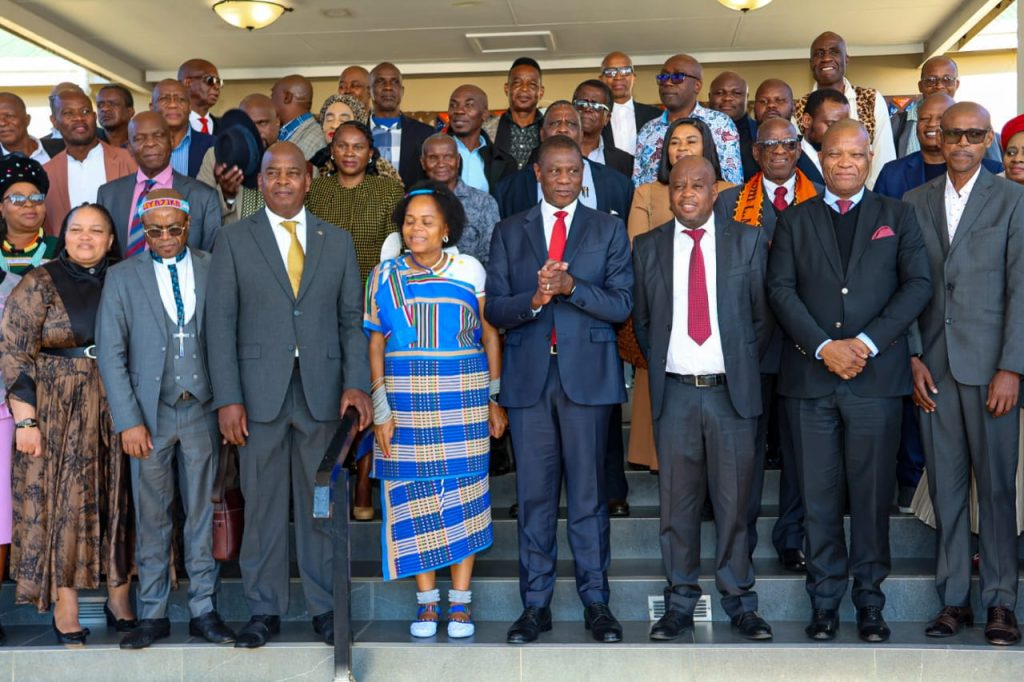
Deputy President Paul Mashatile flanked Deputy Minister of COGTA Prince Zolile Burns-Ncamashe, Chairperson of the Provincial House Hosi Peni Ngove, Premier Dr Phophi Ramathuba, MEC of COGHSTA Basikopo Makamu and Deputy Minister of COGTA Dr Namane Masemola, Traditional Leaders in the background.
On Friday, Deputy President Paul Mashatile visited Polokwane in the Limpopo Province to hold a critical engagement with Senior Traditional Leaders.
The meeting served as a vital platform for the national government and traditional authorities to discuss the state of the institution, address ongoing challenges, and reaffirm their commitment to the development of rural communities.
The gathering began on a sombre note as the Deputy President expressed heartfelt condolences on behalf of the government for the passing of His Majesty King Makhosonke II of the AmaNdebele Kingship. The Deputy President praised the late King for his dedication to empowering rural communities, strengthening the relationship between the government and traditional leadership, and championing cultural preservation.
In his address to the diKgosi and Kgošigadi, Deputy President Mashatile emphasized that their role is central to the nation’s progress. He noted that the government’s purpose in these engagements is not only to listen but also to foster a collaborative approach to governance. He highlighted that Limpopo has made significant strides in supporting traditional leadership, which includes the provision of vehicles, office furniture, and security for senior leaders. Furthermore, the province has allocated grants to Traditional Councils and conducted induction workshops for newly elected members to ensure they are well-equipped to serve their communities.
However, the Deputy President also acknowledged the challenges that remain. He specifically mentioned that the Handbook for Traditional and Khoi-San Leadership is awaiting full concurrence from all provinces, including Limpopo and Mpumalanga. This delay has slowed the national standardization of support and tools of trade for traditional leaders. Additionally, he noted that the institution continues to face pressure due to vacancies in Traditional Councils, which in some cases remain unconstituted because of disputes or litigation.
To address these issues, the Deputy President called for a collaborative approach. He underscored that the national government is ready to work with the Limpopo Provincial Government to ensure that disputes are resolved with legitimacy and fairness, and that resources are distributed equitably.
The Deputy President further urged the traditional leaders to play an active role in addressing the daily needs of their people, which he described as an embodiment of the Ubuntu philosophy. He specifically highlighted several areas of focus:
*Social Issues: Traditional leaders are encouraged to lead efforts in crime prevention, the fight against teenage pregnancy, and the battle against drug and alcohol abuse.
*Climate Change: Given Limpopo’s vulnerability, leaders can help preserve indigenous knowledge to build climate resilience.
*Initiation: As the initiation season approaches, the Deputy President emphasized the necessity of safeguarding the lives of initiates. He commended Limpopo’s proactive stance in establishing the Provincial Initiation Coordinating Committee, which balances cultural heritage with the safety and wellbeing of the youth.
*Democratic Participation: With local government elections scheduled for November 4th, the Deputy President called on leaders to encourage young people to participate in the democratic process to shape the future of their communities.
Concluding the engagement, the Deputy President instructed that the national department and the provincial house prepare a consolidated report for their next meeting. This report is expected to categorize issues into those manageable at the provincial level and those requiring national intervention, ensuring a focused and effective path forward for all involved.
https://shorturl.fm/ZvYvK
https://shorturl.fm/ynMj7