

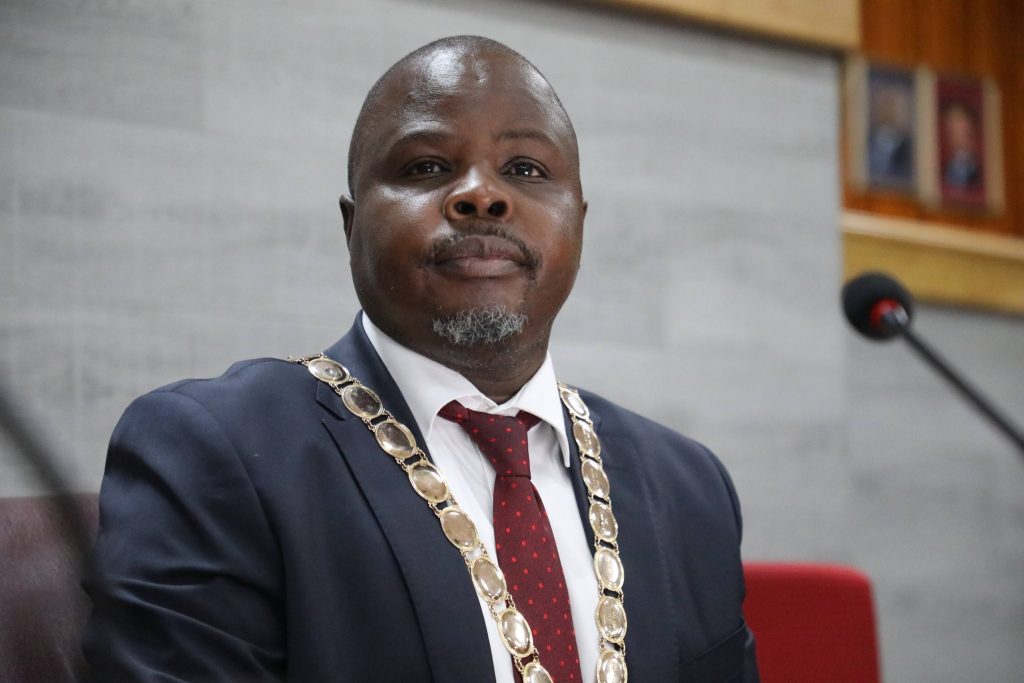
The Mopani District Municipality Executive Mayor, Pule Shayi.
The National Treasury has taken a drastic step to instil fiscal discipline in local government by temporarily withholding the July 2026 equitable share transfers to 69 municipalities across South Africa.
The announcement—made in a media statement on 7 July 2026—has sent shockwaves through local councils, particularly in the Limpopo province. To provide further clarity on this massive financial intervention, the National Treasury has invited members of the media to an urgent briefing on Wednesday, 8 July 2026, from 08:00 to 09:00 at the Ronnie Mamoepa Media Centre in Pretoria. The briefing will be led by the Deputy Minister of Finance, Mr. Ashor Sarupen, who will outline the legal framework underpinning the decision and the strict conditions these municipalities must meet before their money is released.
The decision follows persistent and serious non-compliance with the Municipal Finance Management Act (MFMA) and its supporting regulations. According to the National Treasury, this action is being taken under section 216(2) of the Constitution, read with section 38 of the MFMA. National Treasury emphasized that this is a corrective rather than a punitive measure—meaning the freeze is short-term, and they do not expect it to impact daily service delivery.
Among the 69 blacklisted municipalities nationwide, Limpopo has seen several of its prominent local governments hit by the funding freeze. The affected areas include Musina, Thabazimbi, Modimolle-Mookgopong, Fetakgomo Tubatse—and most notably—the Mopani District Municipality.
The inclusion of the Mopani District Municipality highlights a deep-seated crisis in the region’s financial governance. National Treasury revealed that despite providing years of intensive support—including one-on-one engagements, specialized training forums, and clear compliance circulars—Mopani and the other selected municipalities have continuously failed to adopt funded budgets, address illegal spending, or meet their statutory financial commitments.
A major issue triggering this intervention is the failure of these municipalities to properly manage and process Unauthorised, Irregular, Fruitless and Wasteful Expenditure (UIFWE). Under section 32 of the MFMA, municipal councils are legally required to investigate this wasted money and recover it from the liable individuals, unless a formal council committee investigates and certifies the amount as irrecoverable. National Treasury found that many municipalities have completely bypassed their Municipal Public Accounts Committees (MPACs)—the body responsible for overseeing this accountability—meaning these oversight structures are not functioning effectively. Furthermore, municipalities like Mopani have failed to show that any consequence management is being implemented, such as taking timely disciplinary action, recovering losses, or making criminal referrals.
The latest report from the Auditor-General for the 2024/25 financial year paints a grim picture that entirely backs Treasury’s radical intervention. Since the 2021/22 financial year, South African municipalities have racked up a staggering R24.12 billion in fruitless and wasteful expenditure—alongside a jaw-dropping R145.21 billion in irregular expenditure. In the 2024/25 financial year alone, irregular spending accounted for R40.14 billion. Furthermore, budget credibility has completely collapsed—with 116 municipalities adopting unfunded budgets during the 2024/25 period.
This continuous law-breaking by political and administrative leaders has directly threatened the financial survival of major bulk utility suppliers. By the end of the 2024/25 financial year, failing municipalities owed R3.40 billion in interest to Eskom and R1.21 billion to various water boards. In districts like Mopani—where water provision is a constant and vital challenge—the non-payment of these boards risks severe service disruptions for ordinary citizens. Late payments have also affected third-party deductions and employee contributions—with 48 municipalities failing to pass on these statutory deductions for over a month, negatively impacting the operations of the South African Revenue Service (SARS), the Auditor-General, and the Financial Sector Conduct Authority (FSCA).
National Treasury has made it clear that the July 2026 funds will remain frozen until the affected municipalities submit undeniable proof that they have met strict compliance conditions. Deputy Minister Sarupen’s media briefing on 8 July 2026 will lay out the exact roadmap for these struggling institutions. For the leadership of the Mopani District Municipality and its provincial counterparts, the clock is ticking to clean up their financial acts, enforce consequence management, and rescue their municipal allocations before the local government frameworks fracture entirely.
https://shorturl.fm/QkdkH
https://shorturl.fm/0064s
https://shorturl.fm/Wm2PU